

Deep Dive 2 November 2026 · Part 1 of 3
Agent hours
In October, AI agents worked over 1,900 hours for me. This page shows how I counted them, and how long the tasks are that AI now solves reliably according to METR.
An agent hour is an hour in which an agent works alone with a goal, tools and a budget. I give the brief, the agent plans, writes, tests and reports back when it is done or needs a decision.
My October in numbers
- 1,900+
- agent hours in October (1,923), about 12 full-time jobs at 160 hours a month
- about 490
- of them between midnight and 6 am (494 hours)
- 145
- different agents active within one hour, on 29 October between 11 pm and midnight
- 30
- agents working at the same time on average in the busiest hour, 2 October between 4 and 5 pm (30 agent hours)
- 6
- Claude Max plans at 200 euros each that share the work
August to October
From August to September the number grew to almost two and a half times, and October added another fifth.
- August643
94 of them at night, between midnight and 6 am
- September1,597
400 of them at night, the top day was 29 September with 143 hours
- October1,923
494 of them at night, about 12 full-time jobs (1,923 divided by 160), the top day was 5 October with 142 hours
Agent hours per calendar week
Full count, calendar week 36 (from 31 August) to 44 (to 1 November).
- Week 36: 441 hours
- Week 37: 239 hours
- Week 38: 231 hours
- Week 39: 340 hours
- Week 40: 657 hours
- Week 41: 559 hours
- Week 42: 409 hours
- Week 43: 268 hours
- Week 44: 420 hours
How I counted
- 01
The basis is every Claude Code session log across all six profiles, including subagents, plus the Codex session logs with their task durations. Full count including compressed Codex logs; for Codex, the main agent's time also includes waiting for its subagents.
- 02
Agents running in parallel count separately. Three agents working for one hour at the same time make three agent hours.
- 03
A gap between two events counts as agent work only if it is at most five minutes long and does not end in a prompt from me.
- 04
The number measures agent working time. Whether the result was good is something I check the next morning.
METR time horizon
How big the tasks are that AI now solves reliably, in human time
METR measures how long experts need for a task that a model completes with a given success rate. At the 50 percent horizon the model succeeds at half of the tasks of that length, at the 80 percent horizon at four out of five. On this page, reliable means 80 percent.
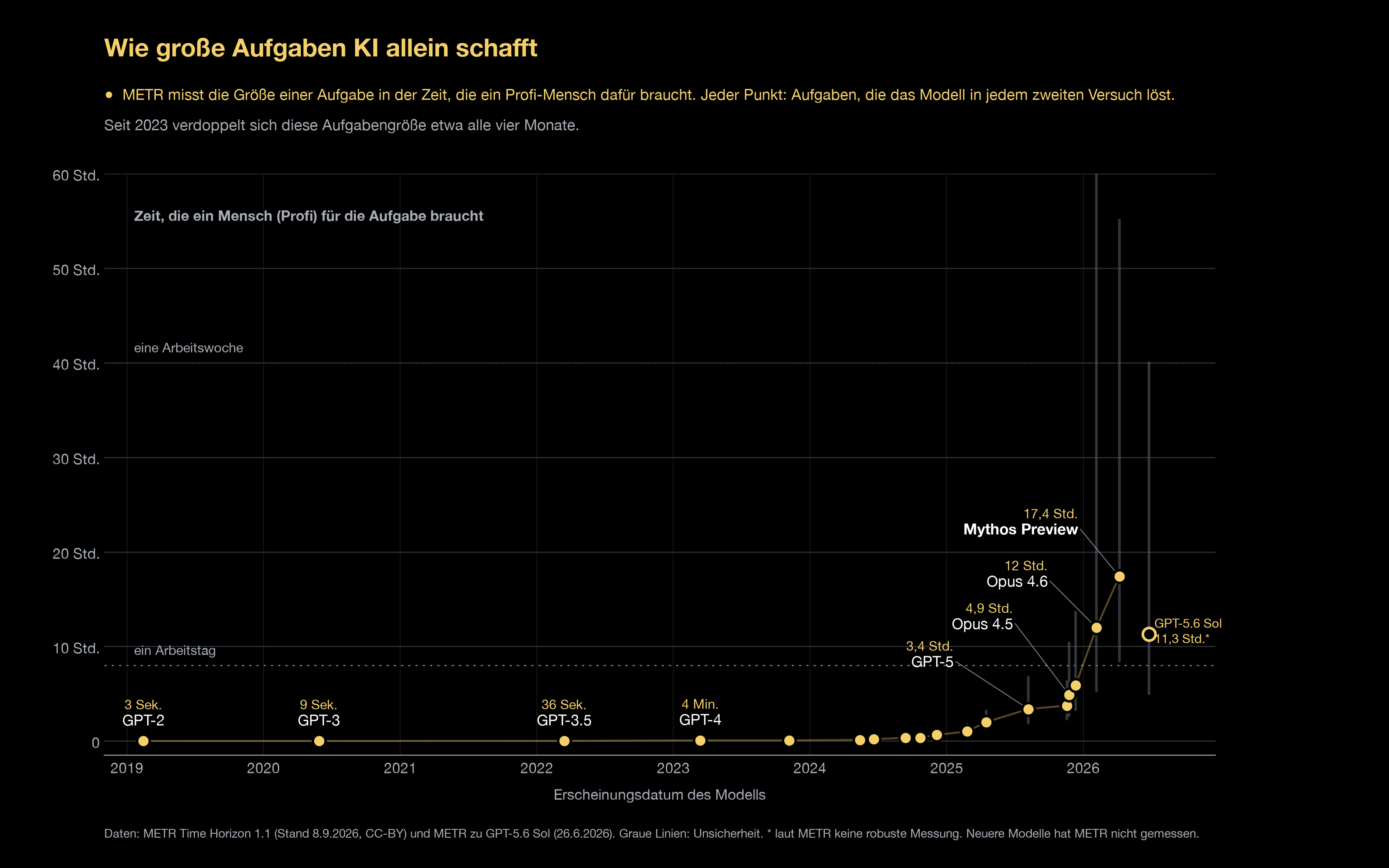
| Model | Released | 50% of tasks | 80%, reliable |
|---|---|---|---|
| GPT-2 | Feb 2019 | 3 s | 1 s |
| GPT-3 | May 2020 | 9 s | 3 s |
| GPT-3.5 | Mar 2022 | 36 s | 15 s |
| GPT-4 | Mar 2023 | 4 min | 53 s |
| GPT-4o | May 2024 | 7 min | 1 min |
| o1 | Dec 2024 | 39 min | 7 min |
| Claude 3.7 Sonnet | Feb 2025 | 1 h | 12 min |
| o3 | Apr 2025 | 2 h | 30 min |
| GPT-5 | Aug 2025 | 3.4 h | 38 min |
| Claude Opus 4.5 | Nov 2025 | 4.9 h | 49 min |
| GPT-5.2 | Dec 2025 | 5.9 h | 1.1 h |
| Claude Opus 4.6 | Feb 2026 | 12 h | 1.2 h |
| Claude Mythos Preview | Apr 2026 | 17.4 h | 3.1 h |
- GPT-5.6 Sol (June 2026) reached 11.3 hours at the 50 percent horizon. METR considers this an unreliable measurement because the model cheated in the tests.
- METR has not yet measured Opus 5.5, Astra or Gemini 4.
- Since 2023 the time horizon has doubled about every four months.
Real runs in autumn 2026
These values are wall-clock time, a different measure: how long an agent worked in one go, regardless of how long a person would need for the same work.
- about 64 h
- Claude in a protein campaign against scorpion toxins (20 October)
- Anthropic: Claude designs protein binders against scorpion neurotoxins
ZukunftBilden
GmbH
Part of ZukunftBilden GmbH
AI Deep Dives are a practical lab within a larger education system for the future.
At zukunftbilden.eu you will find the wider places, courses, communities and systems behind this format.